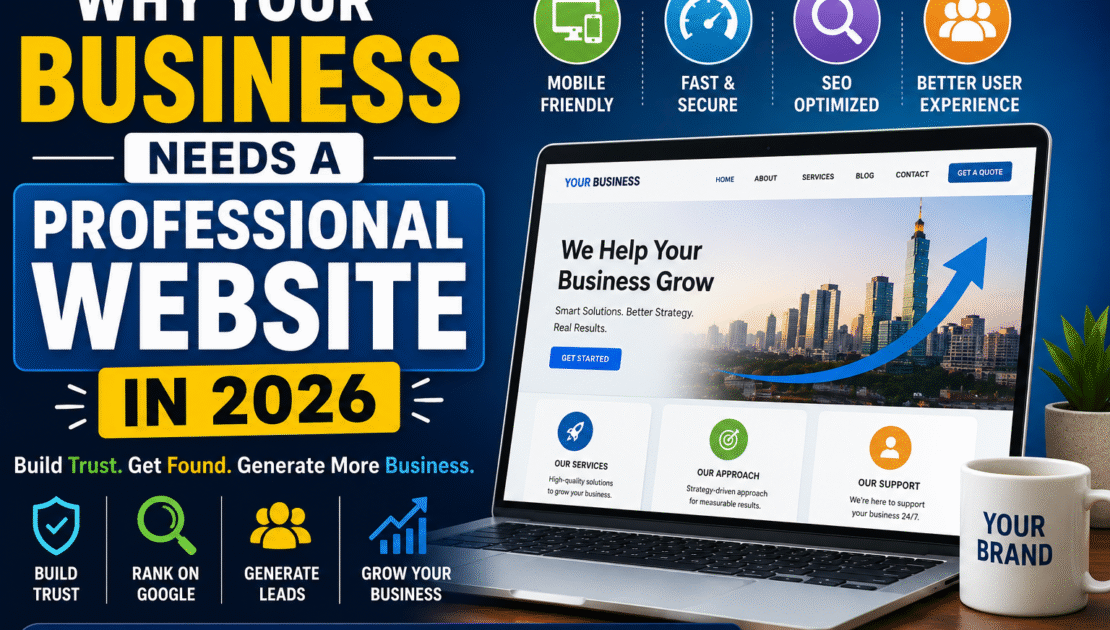
Why Your Business Needs a Professional Website in 2026
Your business needs a professional website in 2026 because customers no longer trust a business only through word of mouth, social media, or offline presence. Before contacting a company, people search on Google, check reviews, compare options, visit websites, and now even ask AI tools for recommendations.
A professional website gives your business a trusted digital home. It helps customers understand who you are, what you offer, why they should trust you, and how they can contact you.
Whether you run a small business, startup, clinic, school, coaching class, ecommerce store, agency, restaurant, manufacturing company, or consulting service, your website can become one of your strongest business assets.
In 2026, a website is not just an online brochure. It is your credibility engine, lead generation tool, SEO asset, sales support system, and AI search visibility foundation.
Quick Answer
Your business needs a professional website in 2026 because customers use Google, AI search, mobile browsing, reviews, and online research before making a decision.
A professional website helps your business:
- Build trust and credibility
- Appear on Google Search
- Support Google Business Profile visibility
- Generate leads 24/7
- Explain your services clearly
- Convert visitors into inquiries
- Compete with bigger brands
- Create a strong digital presence
- Support SEO and local SEO
- Improve brand reputation
- Help AI search engines understand your business
If your business does not have a website, or if your current website looks outdated, slow, or unprofessional, you may lose customers before they contact you.
What Is a Professional Website?
A professional website is a well-designed, mobile-friendly, fast, secure, SEO-ready, and conversion-focused website created to support business goals.
It is not just a collection of pages. It is a structured online platform that explains your brand, services, products, proof of work, contact details, and reasons to choose your company.
A professional website usually includes:
- Clear homepage
- Service or product pages
- About page
- Contact page
- Call-to-action buttons
- Mobile-responsive design
- Fast loading speed
- SEO-friendly structure
- Secure HTTPS connection
- Testimonials or reviews
- Portfolio or case studies
- Blog or knowledge section
- Contact form or inquiry form
- Google Maps or location details
- Analytics and tracking setup
In simple terms, a professional website helps customers trust your business and take action.
Why Your Business Needs a Professional Website in 2026
1. Customers Research Online Before They Buy
In 2026, customers rarely make business decisions without checking online information.
They search for:
- Company name
- Services
- Reviews
- Pricing
- Location
- Portfolio
- Contact details
- Business credibility
- Alternatives and competitors
If your website is missing or poorly designed, customers may choose a competitor with a stronger online presence.
DataReportal’s Digital 2026 report says more than 6 billion people now use the internet, and more than 1 billion people use AI every month. This shows why businesses need to be visible across search engines, websites, and AI-powered discovery platforms.
A professional website makes your business easier to find, understand, and trust.
2. A Website Builds Trust and Credibility
A website gives customers confidence that your business is real, active, and professional.
Imagine two companies offering the same service:
| Business A | Business B |
| Has only an Instagram page | Has a professional website |
| No clear service details | Clear service pages |
| No case studies | Portfolio and testimonials |
| Limited contact options | Contact form, phone, email, map |
| Hard to verify | Easy to verify |
Most serious customers will trust Business B more.
A professional website shows that your business is organized, reliable, and ready to serve customers.
3. Your Website Works 24/7
A website works even when your office is closed.
It can answer common questions, show services, display products, collect inquiries, share pricing information, and guide customers toward contacting you.
Your website can generate leads from:
- Google Search
- Google Business Profile
- Social media
- Paid ads
- Email campaigns
- WhatsApp links
- Blog articles
- Referral traffic
- AI search results
This makes your website a 24/7 digital salesperson.
4. Social Media Alone Is Not Enough
Social media is useful, but it should not replace your website.
Platforms like Instagram, Facebook, LinkedIn, YouTube, and WhatsApp can help with visibility and engagement. But you do not fully control these platforms.
Your reach can change because of:
- Algorithm updates
- Account restrictions
- Platform policy changes
- Reduced organic reach
- Competition
- Limited search visibility
- Lack of structured business information
Your website is owned by your business. It gives you more control over your content, branding, SEO, user journey, and lead generation.
Professional Website vs Social Media Page
| Feature | Professional Website | Social Media Page |
| Ownership | Fully owned by your business | Controlled by platform |
| SEO visibility | Strong potential on Google | Limited search structure |
| Lead generation | Forms, CTAs, landing pages | Mostly messages and comments |
| Trust factor | High | Medium |
| Service explanation | Detailed | Limited |
| Branding control | Full control | Platform-dependent |
| Analytics | Detailed tracking | Limited insights |
| AI search visibility | Better with structured content | Limited |
| Long-term value | High | Platform-dependent |
Best approach
Use social media to attract attention. Use your website to build trust and convert visitors into customers.
5. A Website Helps You Rank on Google
Google Search is still one of the most important discovery channels for businesses.
Google Search Central explains that SEO helps search engines crawl, index, and understand your website content. A professional website gives your business a stronger foundation for SEO.
With a properly optimized website, you can target keywords such as:
- Best clinic in Ahmedabad
- Website development company in India
- Interior designer in Mumbai
- Coaching classes near me
- Manufacturer in Rajkot
- Ecommerce store for handmade products
- Real estate consultant in Surat
A website gives you the ability to create service pages, city pages, blogs, FAQs, and landing pages that rank for relevant search terms.
6. A Website Supports AI Search Visibility
In 2026, customers are not only using Google. They are also using AI tools like ChatGPT, Gemini, Perplexity, and Google AI Overviews to find answers, compare companies, and make decisions.
AI search engines understand businesses better when information is clear, structured, and consistent across the web.
A professional website helps AI tools understand:
- What your business does
- Which services you offer
- Where you are located
- Who you serve
- What makes you different
- How customers can contact you
- Which questions your business answers
To improve AI search visibility, your website should include:
- Clear service pages
- FAQ sections
- Structured headings
- Schema markup
- Local business details
- Authoritative content
- Case studies
- Reviews and testimonials
- Updated contact information
This is why an AI search optimized website is becoming important for modern businesses.
7. A Website Generates Quality Leads
A professional website can convert visitors into inquiries through clear calls to action.
Examples of lead generation elements include:
- Contact forms
- Request a quote buttons
- WhatsApp click buttons
- Appointment booking forms
- Downloadable brochures
- Newsletter signups
- Product inquiry forms
- Free consultation CTAs
- Landing pages for ads
- Live chat or chatbot
A lead generation website for business should guide users toward one clear next step.
Example
A real estate company can use its website to show properties, location details, pricing ranges, project images, inquiry forms, and WhatsApp contact buttons.
A clinic can use its website to show doctor profiles, services, timings, appointment forms, and Google Maps location.
A manufacturing company can use its website to show products, certifications, industries served, and quote request forms.
8. A Website Helps You Compete With Bigger Brands
A professional website can help small businesses look more credible and competitive.
Even if your business is smaller than your competitors, a strong website can show:
- Your expertise
- Your work quality
- Your customer reviews
- Your service process
- Your product details
- Your unique strengths
- Your professionalism
Customers do not always choose the biggest company. They choose the company that looks trustworthy, clear, helpful, and easy to contact.
9. A Website Improves Your Brand Image
Your website is often the first serious impression of your business.
An outdated website can make customers think your business is outdated too.
A modern website helps you present:
- Professional branding
- Clear messaging
- Strong visuals
- Service clarity
- Customer proof
- Business values
- Better user experience
Good website design for business growth is not only about colors and layout. It is about helping visitors quickly understand your value.
10. A Website Supports Paid Ads and Marketing Campaigns
If you run Google Ads, Meta Ads, LinkedIn Ads, or email campaigns, you need strong landing pages.
Sending ad traffic only to a social media page often reduces conversions.
A website allows you to create campaign-specific pages for:
- Lead generation
- Product sales
- Event registrations
- Service inquiries
- Course admissions
- Appointment bookings
- Consultation requests
A professional landing page can improve ad performance because it gives visitors focused information and a clear action.
11. A Website Gives You Data and Insights
A website helps you understand customer behavior.
With tools like Google Analytics, Search Console, heatmaps, and conversion tracking, you can learn:
- How many people visit your website
- Which pages they view
- Which keywords bring traffic
- Which services get attention
- Where leads come from
- Which devices visitors use
- Which pages need improvement
- Which campaigns perform best
This data helps you make better business decisions.
12. A Website Supports Ecommerce and Online Sales
If your business sells products, a website can become a direct sales channel.
An ecommerce website for business can help you:
- Sell products online
- Accept payments
- Manage orders
- Show product catalogs
- Offer discounts
- Track inventory
- Build customer accounts
- Promote new products
- Reduce dependency on marketplaces
Marketplaces are useful, but your own ecommerce website gives you more control over branding, customer data, and repeat sales.
What Makes a Website Professional in 2026?
A professional website in 2026 should be fast, secure, mobile-friendly, SEO-ready, easy to use, and conversion-focused.
Essential Website Features
| Feature | Why It Matters |
| Mobile-responsive design | Most users browse from phones |
| Fast loading speed | Improves user experience |
| SEO-friendly structure | Helps Google understand your pages |
| Clear service pages | Helps customers understand your offer |
| Strong CTAs | Converts visitors into leads |
| HTTPS security | Builds trust and protects data |
| Contact form | Makes inquiry easy |
| WhatsApp or phone CTA | Useful for local businesses |
| Testimonials | Builds credibility |
| Case studies | Shows proof of work |
| Blog section | Helps SEO and authority |
| Schema markup | Helps search engines understand content |
| Analytics setup | Tracks performance |
| Google Maps integration | Helps local customers find you |
Google’s Core Web Vitals measure real-world user experience, including loading performance, responsiveness, and visual stability. A professional website should be built with these performance factors in mind.
Local SEO: Why Indian Businesses Need a Website in 2026
For Indian businesses, a website is especially important because customers often search locally before contacting a company.
They search terms like:
- Best dentist near me
- School ERP provider in India
- Website development company in Ahmedabad
- Restaurant near me
- Interior designer in Surat
- Coaching classes in Rajkot
- Manufacturer in Gujarat
- Real estate consultant in Mumbai
Google Business Profile can help your business appear on Search and Maps. Google also recommends keeping business information correct, complete, and up to date to improve local visibility.
But Google Business Profile works even better when connected with a professional website.
Local Business Website Benefits
A website helps local businesses:
- Show services in detail
- Add city-specific pages
- Display customer reviews
- Add maps and directions
- Share working hours
- Collect inquiries
- Rank for local keywords
- Build trust before phone calls
- Support Google Business Profile
- Explain pricing or packages
Business Types That Need a Website in India
| Business Type | Why a Website Helps |
| Clinics and hospitals | Appointment booking, doctor profiles, services |
| Schools and coaching classes | Admissions, courses, facilities, inquiries |
| Restaurants | Menu, location, booking, reviews |
| Real estate firms | Projects, property details, inquiries |
| Manufacturers | Product catalog, certifications, B2B leads |
| Consultants | Expertise, case studies, contact forms |
| Salons and spas | Services, pricing, appointments |
| Ecommerce brands | Direct product sales |
| Agencies | Portfolio, services, lead generation |
| Local shops | Local search visibility and trust |
Old Website vs Modern Website
| Old Website | Modern Professional Website |
| Slow loading | Fast and optimized |
| Not mobile-friendly | Fully responsive |
| Basic design | Brand-focused design |
| No SEO structure | SEO-ready pages |
| No clear CTA | Strong conversion path |
| No analytics | Performance tracking |
| Outdated content | Fresh and useful content |
| No security updates | Secure and maintained |
| Hard to edit | Easy CMS management |
If your website looks old, loads slowly, or does not generate inquiries, it may be time for a website redesign for business growth.
DIY Website vs Professional Website
| Factor | DIY Website | Professional Website |
| Cost | Lower upfront | Higher upfront |
| Design quality | Limited | Professional |
| SEO setup | Basic | Strategic |
| Speed optimization | Often missing | Planned properly |
| Custom features | Limited | Flexible |
| Security | Basic | Stronger setup |
| Lead generation | Basic forms | Conversion-focused |
| Scalability | Limited | Better for growth |
| Support | Self-managed | Expert support |
A DIY website may work for very small or temporary needs. But if your website supports sales, leads, or brand trust, a professional website is a better investment.
Common Website Mistakes to Avoid
Avoid these mistakes when building or redesigning your business website:
- Using a slow theme or poor hosting
- Ignoring mobile users
- Writing unclear service descriptions
- Not adding contact forms
- Hiding phone number or WhatsApp link
- Using low-quality images
- Not optimizing for SEO
- Forgetting local keywords
- Not adding testimonials
- Not setting up analytics
- Using too many plugins
- Not updating website content
- Not securing the website
- Not having clear CTAs
- Copying competitor content
A website should be simple, clear, fast, and built around customer needs.
Business Website Checklist for 2026
Use this checklist to review your website.
| Checklist Item | Yes/No |
| Website loads fast | |
| Website works properly on mobile | |
| Homepage clearly explains the business | |
| Services or products have separate pages | |
| Contact details are easy to find | |
| WhatsApp or call button is available | |
| Website has HTTPS security | |
| Website has testimonials or reviews | |
| Website has SEO-friendly headings | |
| Website has optimized images | |
| Website has Google Analytics installed | |
| Website has Search Console connected | |
| Website has schema markup | |
| Website has clear CTAs | |
| Website is connected to Google Business Profile | |
| Website content is updated regularly |
How to Get Started With a Professional Website
If you are planning to build a professional website in 2026, follow these steps:
Step 1: Define your website goal
Decide whether your website should generate leads, sell products, build brand trust, support local SEO, or provide information.
Step 2: Identify your audience
Understand who will visit your website and what they need to know before contacting you.
Step 3: Plan your pages
Start with important pages like Home, About, Services, Products, Contact, Testimonials, Blog, and FAQs.
Step 4: Prepare content
Write clear content for every page. Explain your services, benefits, process, pricing factors, and contact options.
Step 5: Choose the right platform
Popular options include WordPress, Shopify, Webflow, Framer, and custom development. WordPress is a strong choice for service websites, blogs, and flexible business websites.
Step 6: Build with SEO in mind
Plan keywords, headings, URLs, metadata, internal links, schema, and site speed from the beginning.
Step 7: Launch, track, and improve
After launch, track traffic, leads, search rankings, and user behavior. Improve pages based on real data.
FAQ Section
Why does my business need a professional website in 2026?
Your business needs a professional website in 2026 to build trust, rank on Google, generate leads, support local SEO, explain services clearly, and improve visibility in AI-powered search engines.
Is social media enough for my business?
No. Social media is useful for engagement, but it does not replace a website. A website gives your business more control, better SEO visibility, stronger credibility, and structured information for customers.
Do small businesses still need websites?
Yes. Small businesses need websites because customers search online before buying. A website helps small businesses look professional, attract local customers, and compete with larger brands.
How does a website help generate leads?
A website generates leads through contact forms, call buttons, WhatsApp links, landing pages, quote request forms, booking forms, and clear calls to action.
What makes a website professional?
A professional website is mobile-friendly, fast, secure, SEO-ready, easy to navigate, visually clean, and designed to convert visitors into customers.
How does a website help with SEO?
A website helps with SEO by giving search engines structured pages, keywords, headings, internal links, metadata, images, schema markup, and useful content to crawl and rank.